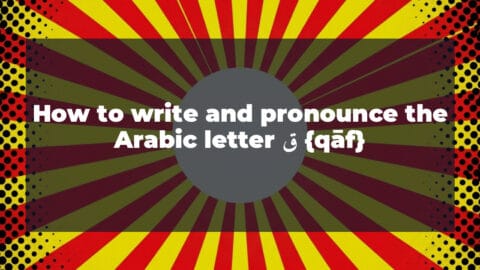

 This is a detailed guide on how to write and pronounce the Arabic letter: ك كـ {kāf}
With this video, we provide easy tips and techniques through which writing and pronouncing the Arabic letters become an easy task to do.
🚥 Timestamp: 🚥
00:00 Intro to the letter ك كـ {kāf}
00:10 How to write the Arabic letter ك كـ {kāf}
00:55 How to pronounce the Arabic letter ك كـ {kāf}?
01:25 The different forms of writing the letter ك كـ {kāf} according to its positions.
02:30 How to pronounce the Arabic letter ك كـ {kāf} with harakat (Arabic vowles); Shaddah, damma, kassrah, tanween, sukoun, mad?
03:05 Let’s practice how to pronounce the letter ك كـ {kāf}.
The Arabic letter ك (kāf – كَاف) is the 22nd letter of the Arabic alphabet. It represents the /k/ sound, similar to the k in English words like kite, key, and book. Due to its near-identical pronunciation, it is one of the easiest Arabic letters for English speakers to learn.This lesson will guide you on how to write ك, pronounce it correctly, and recognize its different forms within Arabic words.
Basic Information
- Letter Name: كَاف (kāf)
- Arabic Letter: ك
- English Approximation: k
- IPA Pronunciation: /k/
- Type: Consonant
- Position in Arabic Alphabet: 22nd
How to Pronounce ك
The letter ك is pronounced by:
- Raising the back of your tongue until it touches the soft palate (the soft area near the back of the roof of your mouth).
- Completely stopping the airflow for a brief moment.
- Releasing the air without vibrating your vocal cords.
This creates a clear k sound.
Examples in English:
- kite
- keep
- king
- book
- cook
The Arabic ك is generally pronounced just like the English k.
Writing the Letter ك
Like almost every Arabic letter, ك changes its shape depending on its position in a word.
Independent form
ك
Beginning of a word
كـ
Middle of a word
ـكـ
End of a word
ـك
Although the shape changes, the pronunciation always remains /k/.
Stroke Order
To write ك correctly:
- Begin with a short downward stroke.
- Draw the curved body of the letter.
- Add the small angled mark above the letter.
When connected to other letters, the shape becomes smoother but follows the same basic structure.
Practice writing:
ك ك ك ك ك
Then practice connected forms:
كـ كـ كـ
ـكـ ـكـ ـكـ
ـك ـك ـك
The Letter ك with Short Vowels
Arabic uses short vowel marks called ḥarakāt.
كَ (ka)
Pronounced like ka in karate.
Examples:
- كَتَبَ (kataba) — he wrote
- كَلْب (kalb) — dog
كِ (ki)
Pronounced like ki in kit.
Examples:
- كِتَاب (kitāb) — book
- كِبَار (kibār) — كبار (adults/elderly)
كُ (ku)
Pronounced like ku in cool, but shorter.
Examples:
- كُرْسِي (kursiyy) — chair
- كُرَة (kurah) — ball
The Letter ك with Long Vowels
كَا (kā)
Example:
- كَاتِب (kātib) — writer
كِي (kī)
Example:
- كِيلُو (kīlū) — kilogram (loanword)
كُو (kū)
Example:
- كُوب (kūb) — cup (borrowed word in some dialects)
Examples of Words Containing ك
| Arabic | Transliteration | Meaning |
|---|---|---|
| كِتَاب | kitāb | book |
| كَلْب | kalb | dog |
| كَبِير | kabīr | big |
| سَمَك | samak | fish |
| مَلِك | malik | king |
| مَكْتَب | maktab | office, desk |
| كُرْسِي | kursiyy | chair |
| شُكْرًا | shukran | thank you |
Notice that ك may appear at the beginning, middle, or end of a word while keeping the same k sound.
Common Pronunciation Mistakes
1. Confusing ك with ق
These are different letters.
- ك = /k/
- ق = deeper /q/ sound produced farther back in the throat.
Examples:
- كَلْب (kalb) — dog
- قَلْب (qalb) — heart
Changing the letter changes the meaning completely.
2. Making the Sound Too Strong
The Arabic ك should sound natural and relaxed.
Avoid adding an extra burst of air like some English speakers do in words such as key.
3. Replacing ك with خ
Some beginners mistakenly pronounce ك from the throat.
Remember:
- ك = k
- خ = rough kh sound
These letters are completely different.
Practice Reading
Read the following aloud several times:
- كَ
- كِ
- كُ
- كَا
- كِي
- كُو
Now read these words:
- كِتَاب (kitāb)
- كَلْب (kalb)
- كَبِير (kabīr)
- مَكْتَب (maktab)
- سَمَك (samak)
- شُكْرًا (shukran)
Focus on producing a clean k sound every time.
Quick Summary
Regular practice with common words such as كِتَاب (kitāb), كَلْب (kalb), and شُكْرًا (shukran) will help you master both writing and pronunciation.
- ك (kāf) is the 22nd letter of the Arabic alphabet.
- It represents the sound /k/, like the k in kite.
- It is pronounced by touching the back of the tongue to the soft palate and releasing the airflow.
- It changes shape depending on its position in a word: ك, كـ, ـكـ, ـك.
- It combines with short vowels to form كَ, كِ, and كُ.
- Do not confuse ك with ق, which has a deeper q sound.
- Regular practice with common words such as كِتَاب (kitāb), كَلْب (kalb), and شُكْرًا (shukran) will help you master both writing and pronunciation.